
Professor Dr. Yvonne Rogers
Moving from Human-Centred AI to People-Centred AI
Recently there has been much excitement about agentic AI. But what does this mean for those of us working in HCI? Rather than focussing on how to amplify human cognition or augment users with GenAI tools it is important that we also begin considering how best to empower organisations, companies and society at large with agentic AI. In particular, we need to determine how to support teams and organisations in their workflows and complex tasks, for example, collaborative decision-making. This involves addressing scalability; coming up with different lens and frameworks. In my talk, I will consider the new challenges that are afoot and the opportunities that have arisen as we enter the new era of agentic AI.

Bio: Yvonne Rogers is a Professor of Interaction Design and the director of UCLIC at University College London. Her research is concerned with designing interactive technologies that can empower humans, especially human-centred AI, and how to develop AI tools to think with. Central to her work is a critical stance towards how visions, theories and frameworks shape the fields of HCI, cognitive science and ubiquitous computing. She been instrumental in promulgating new theories (e.g., external cognition), alternative methodologies (e.g., in the wild studies) and far-reaching research agendas (e.g., “Being Human” manifesto) and has pioneered an approach to innovation and ubiquitous learning. She has received various awards including being elected as an international member of the American National Academy of Engineering, the ACM SIGCHI Lifetime Achievement Research Award, a Fellow of the Royal Society and the Royal Society Robin Milner Medal for computer science. She was also awarded a Chair of Excellence from the University of Bremen. She is one of the authors of the definitive textbook on Interaction Design and HCI now in its 6th edition, that has sold over 300,000 copies worldwide and has been translated into many languages.
Professor Dr. Mattia Thibault
Interreal translation: travelling across realities in the Media Multiverse
Despite talks about a single, unified, “metaverse”, our mediascape seems to have taken the shape of a multiverse: diverse, fragmented, and kaleidoscopic. In this Multiverse, objects, spaces and subjects circulate from a “reality” to another, across different media and environments, continuously translated, maintaining some common characteristics, but always adapting to new contexts. You can think of heritage buildings translated in VR, of digital twins that attempt to reach equivalence between material and digital objects, or even the efforts to translate humans in computer, from GreifTech to dreams of mind upload.
In this presentation, we will try to understand what is the “beating heart” behind this circulation and hypothesise that it is the human desire to transcend the material world and to ascend to a digital realm that is often depicted as immaterial and eternal. We will look both at current examples of interreal translations, as well as future speculations and narratives of what the future of our mediascape might be. Between practical implementation and media ideology, we will try to identify the “pulse” that pushes us to translate ourselves, and our world, into new realities.
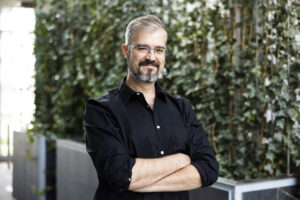
Bio: Dr Mattia Thibault is a Professor in Translation in the Creative Industries at Tampere University and has a PhD in Semiotics and Media (Turin University). His research interests include semiotics and translation, extended realities, speculative research, and playfulness in the built environment (real and digital). He is the leader of the InterReality Research Group which focuses on the relations between different virtual (including both “digital” and “possible”) spaces and their connections with the “real” world. He is PI of the projects InterReal (ERC-StG), NEXR (Business Finland Co-Research) and Mobility Mindshift (funded by Net Zero Cities, EU).
Senior Designer Dr. Pontus Wärnestål
AI, Responsibility, and Better Decisions in an Age of Hype
“Artificial intelligence” has become an umbrella term for a wide range of technologies – classification, prediction, optimization, generative models, decision support systems – many of which are valuable in specific contexts. Yet the framing of these systems, especially generative services, as intelligent, general, or inevitable has made it increasingly difficult to evaluate them critically, responsibly, and in proportion to their actual capabilities and costs.
This keynote argues that the central challenge facing researchers, leaders, and practitioners today is not whether to adopt “AI,” but how to reason clearly about what these systems are, what they are not, and what kinds of societal commitments their deployment entails. There is no ”intelligence” to be found in contemporary AI systems – but there may still be value in carefully bounded applications such as semantic modeling, synthetic data generation, decision support, and large-scale pattern recognition.
Grounded in research across HCI, cognitive science, AI governance, and political economy, the talk examines how hype-driven narratives obscure real trade-offs related to labor, energy, language, power, accountability, and institutional responsibility. It challenges the assumption that scale and efficiency automatically constitute progress, and instead proposes a governance-oriented framework for evaluating AI technologies based on purpose, proportionality, risk, and public interest.
The goal is not to reject AI per se, but to equip the CHI community with sharper conceptual tools – so that design, research, and policy decisions are made with clarity rather than momentum, and with responsibility rather than resignation.

Bio: Pontus Wärnestål is an award-winning designer, HCI researcher, author, and educator with 25 years of experience at the intersection of human-centered design, emerging technologies, digital culture, and AI. With a PhD in Computational Linguistics and a background spanning academia, startups, and global design agencies, Pontus has led initiatives across UX, service design, and AI innovation. He is the author of the book “Designing AI-Powered Services” (2021), has published several research papers, including a Best of CHI research paper in 2014. He frequently speaks on how design can shape meaningful, responsible AI systems. Currently Senior Designer and Head of Pedagogy at Ambition Group and Deputy Professor at Halmstad University, Pontus is passionate about exploring better futures.