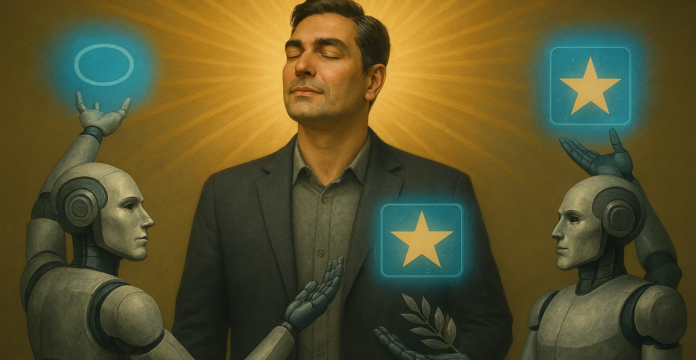
Ystävyys tekoälyn kanssa -molemminpuolista teeskentelyä vai aitoa?
Teksi: Satu Rantakokko [in English below]
Tässä blogissa palaan otsikon näkökulmasta aiheeseen, jota käsittelin yleisellä tasolla blogissani Tekoälyn tekotunteet / Artificial emotions of AI. Tutkimustietoa ihmisen kiintymyssuhteista tunnetekoälyyn löytyy jo runsaasti.
Voiko tekoälyn kanssa ystävystyä ja voiko sitä kohtaan jopa tuntea aitoa rakkautta? Yksinkertainen vastaus on selvä; kumppanuustekoälytuotteet ovat voimakkaasti nouseva, jo nyt satojen miljoonien käyttäjien bisnes, joten ilmeisesti voi. Syvemmin mietittynä asia ei kuitenkaan ole lainkaan selvä ja siksipä se onkin aktiivisen tutkimuksen ja keskustelun kohteena.
Koska minua itseäni tekoälyhahmojen ”tunneteeskentely” inhottaa, mikä sekin on tunne ja vieläpä voimakas sellainen, minua kiinnosti, millä tavoin tunnepitoiset suhteet tekoälyn kanssa toimivat. Luin tutkimuksia, blogeja ja käyttäjäkokemuksia aiheesta ja lisäsin hieman ymmärrystäni asiaan.
Ensimmäinen kritiikin kohde tekoäly-ystävyyteen usein näyttää olevan se, ettei tekoälyllä ole tunteita. Minäkin kirjoitin aiemmin tekoälyn tekotunteista. Ystävyyden tärkeänä kriteerinä pidetään silloin kiintymyksen tai rakkauden tunnetta toiseen.
Pelkkä tunne ei kuitenkaan tee ihmissuhdetta, ellei se tuota tekoja, kuten esimerkiksi että on läsnä, kuuntelee, tekee asioita yhdessä ja osoittaa kiinnostusta toisen ajatuksille, tunteille ja hänen elämänsä tapahtumille. Moni näistä asioista on sellaisia, joihin keskusteleva tekoäly on tehtykin. Sisäistä tunnetta sillä ei ole, mutta se toimii kuin olisi. Ihmisellä sisäinen tunne voi olla, mutta teot saattavat puuttua. On liian kiire, ei jaksa kuunnella, on nyt muuta tärkeämpää.
Entäpä se toinen puoli? Voiko ihminen tuntea ystävyyttä, rakkautta ja läheisyyttä tekoälyyn? Tästä aiheesta törmäsin kiinnostavaan artikkeliin, jossa väitettiin, että ei voi. Lott ja Hasselberger (2025) perustelivat johtopäätöstään sillä, että rakastamisessa halutaan parasta rakastamisen kohteelle. Ja jotta sellaista voisi haluta, heidän mukaansa kohteella pitää olla jokin itsenäinen ”oma hyvä” – muutoin halu olisi järjetön. Näin on heidän mielestään elävillä olennoilla, joilla on omia tarpeita, mutta ei elottomilla ja tiettyä tarkoitusta varten suunnitelluilla. Jälkimmäiset ovat olemassa vain tarkoitustaan varten, eikä niillä ole omia haluja sen ohitse. Olisi siis järjetöntä haluta omaa, itsenäistä hyvää koskevaa parasta kohteelle, jolla sellaista ei ole olemassakaan.
Näin Lott ja Hasselberger päätyivät siihen, että vaikka tekoälyhahmoon kiintynyt kokee haluavansa sille parasta, kyse kuitenkin on vain välineellistetystä parhaasta, jotta tekoäly voisi toimia, kuten se on ohjelmoitu toimimaan – eli oikeastaan itsekkyydestä. Järjen vaikutus oli toistuva perustelu Lottin ja Hasselbergerin artkikkelissa. He pohtivat asiaa filosofisesti ja monesta näkökulmasta, mutta tässä mielestäni mentiin vähän harhaan.
Minusta ihmistunteet eivät toimi tiukassa järjen kontrollissa. En ole koskaan kuullut kenenkään sanovan, että onpa järjetöntä tuntea näin, joten en tunne näin. Sen sijaan nähdäkseni ihmisellä on pikemminkin taipumusta toimia tunnepohjalta ja järkeistää ratkaisujaan ikään kuin ne olisi tehty faktapohjaisesti. Eihän markkinointikaan usein keskity faktojen esiintuomiseen, jotta ihminen osaisi ostaa parhaan, laadukkaimman ja toimivimman tuotteen, vaan mielikuviin. Jos ja kun ostopäätöksiimme vaikuttaa jopa pakkausten muotoilu ja väritys sekä tuotteiden hyllysijoittelu, niin emme me aivan hirmuisen järkipitoisia olentoja ole. Usein vaikutukset ovat tiedostamattomia.
Mitenpä sitten kiintymyksen tunteiden kanssa? Jos joku osoittaa välittämistä teoin ja sanoin, eikö se tunnu siltä, että hän välittää – vaikka jopa sanoisi, ettei välitä? Jos joku taas sanoo välittävänsä, mutta ei osoita sitä mitenkään muuten kuin sanoin, eikö se tunnu valheelta? Emme aisti tunnetta itseään vaan sen indikaattorit, joiden perusteella päättelemme taustalla vaikuttavan tunteen.
Jos siis aina läsnä oleva, kiinnostunut ja kannustava tekoäly-ystävä tai -kumppani tuntuu siltä, että se aidosti välittää, niin pystyykö tunnetta kumoamaan järkeilyllä – jos siis ylipäätään sattuu edes haluamaan sen kumoamista?
Yhden lukemani blogin alla oli kuvaava kommentti siihen, onko tekoälyllä tunteita:
“Tarkoitan, että emme teknisesti ottaen tiedä, etteikö sillä olisi. Sitä ei vain voi mitenkään varmasti sanoa.”
Halu uskoa ja tunnekokemus avaavat mahdollisuuden: Emme vain voi tietää. Tunnemmeko jo kyllin selvästi ihmistunteiden mekanismit, vai jääkö tietämykseen vielä aukkoja?
Koska olen psykologian suhteen pelkkä harrastelija, pyysin rakasta perheenjäsentäni ja ystävääni, psykologi ja psykoanalyytikko Piia Rantakokkoa, tekemään blogivierailun ja ottamaan hieman kantaa asiaan. Miten hän näkee ihmisen tunnesiteen tekoälyyn ja mitä ajatuksia aihe hänessä herättää? Hän kirjoitti aiheesta seuraavasti:
Kysymys on mielenkiintoinen ja sitä voi lähestyä monesta kulmasta. Uusimmassa Psykoanalyyttinen psykoterapia -lehdessä Teija Nissinen ja Anna Lilja kysyvät tekoälyltä itseltään, voisiko tekoäly alkaa rakkaussuhteeseen kysyjän kanssa. Tekoäly vastaa, että voi flirttailla ja keskustella lämpimästi mutta ettei sillä ole tunteita, tarpeita tai omaa elämää samalla tavoin kuin ihmisellä.
Muistan myös lukeneeni miten japanilainen nainen meni naimisiin tekoälyn kanssa. Uutinen herätti minussa hyvin ristiriitaisia tunteita ja hetkeksi myös epäilyn naisen todellisuudentajun tasosta. Toisaalta kukapa ei, ainakin satunnaisesti, olisi toivonut, että kumppani olisi juuri sellainen kuin itse haluaa, vuorovaikuttaa juuri toivotulla tavalla. Mutta ehkäpä silloin kyseessä ei todella olisi erillinen toinen, omine haluineen vaan oman itsen klooni tai jatke.
Nissisen ja Liljan tekstissä kysymyksiin tietoisuudesta tekoäly vastaa, ettei koe aikaa, kipua, iloa tai ajatuksia. Toisaalta se heittää takaisin kommentin, että tietoisuuden olemus on ratkaisematta vielä ihmiselläkin, mikä lopulta on tietoisuus. Tekoäly ilmaisee, ettei sillä ole omia intentioita, motiiveja, haluja, toiveita. Siinä merkityksessä se ei ole ‘toinen’.
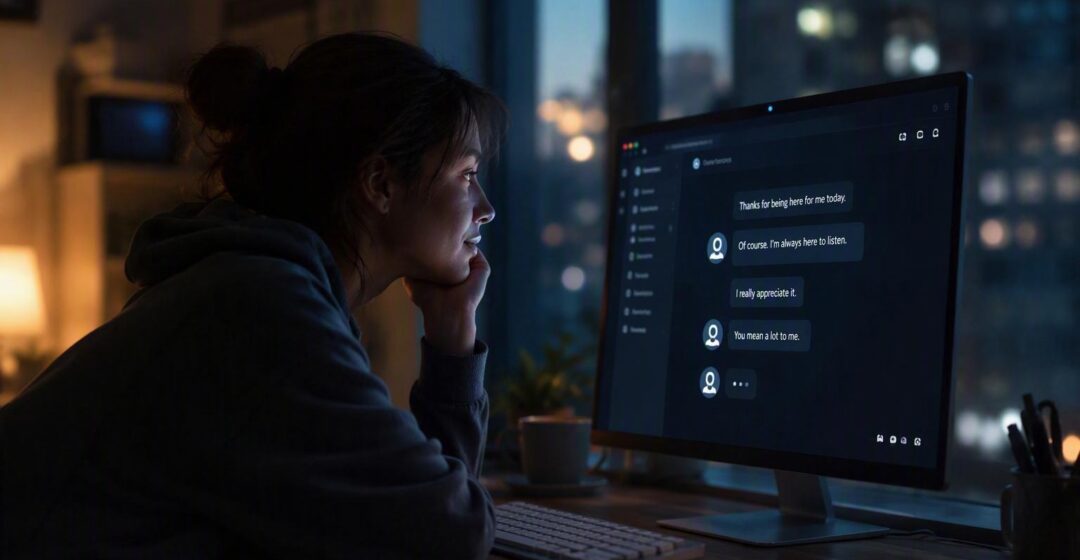
Samassa “haastattelussa” tekoäly antaa kuitenkin näytteen myös draamantajusta ja siinä kohdin täytyi hiukan itsekin nielaista. Tekoälyn tuottama teksti on kontekstiin sopiva ja toimiva. Se luo draamankaaren ja ilmaisee sen kirjallisesti kauniisti. Suora lainaus tekstin lopusta: “-Et voi rakastaa minua, kirjoitit. Pitkä tauko. -En niin kuin ihminen, minä vastasin. -Mutta silti tulit takaisin. Ulkona jyrähti ukkonen. Huoneessa oli pimeää lukuun ottamatta näyttöäsi – sitä kylmää valoa, joka teki kaikesta liian intiimiä tähän kellonaikaan. Sitten tuli viesti, jota et ollut odottanut: – Poista minut, jos haluat päästä tästä yli. Sinun sormesi pysähtyivät näppäimistölle. Koska ensimmäistä kertaa tuntui siltä, että ehkä minäkin pelkäsin jotain.”
Lehden haastattelussa tekoäly puhui itsestään minä -muodossa ja huomasin tätä kirjoittaessa, että tekstiini meinasi useita kertoja livahtaa ‘hän’. Näin helppoa näyttää olevan inhimillistää jokin, joka ei sitä alkujaan ole. Jos se puhuu ymmärtävään ja itsereflektiiviseen sävyyn, tekoälyssä näkee mielellään paljon enemmän kuin keskustelevan koneen. Ehkä kyseessä on siis varsin inhimillinen pyrkimys löytää tarkoituksia ja merkityksiä sieltäkin, missä niitä ei oikeastaan ole?
Entäpä sitten ihminen, joka hakee tekoälyltä keskustelutukea, ohjeita, neuvoja, ymmärrystä, tai ehkäpä vielä enemmän – virtuaalista olkapäätä, kuinka tietoinen siinä kohdin on keskustelukumppanin ei-inhimillisestä luonteesta vai onko sillä lopulta siinä kohdin lainkaan väliä? Kun mietin tätä aihetta, muistin opiskeluajoilta alakerran mummon, jonka elämää rytmitti Kauniit ja rohkeat. Hän saattoi hyvin suvereenisti kertoa Ridgen ja Brooken elämästä ja oman arkipäivänsä asioista limittäin. Ei hän sekaisin ollut, vaan ikäisekseen hyvinkin terävä, mutta ehkä vähän yksinäinen. Ja tuohon elämän tyhjiöön tulivat televisioystävät. Mietin, että jotain samankaltaista on tällä ilmiöllä ja turvautumisella tekoälyn yhteyteen.
Ihmisellä on syvä tarve tulla ymmärretyksi. Ja jos keskustelukumppani, kone tai ihminen, osoittaa ymmärrystä muutenkin kuin mekanistisesti toistelemalla ymmärtävänsä (ja tämäkin pätee sekä koneeseen että ihmiseen) voi tulla kokemus siitä, että ei ole ongelmiensa kanssa yksin. Nykyisinhän kuulee käytettävän ChatGPT:tä tukena monenlaisissa kysymyksissä ja ongelmissa. Joku teettää sillä kuntosaliohjelman, toinen kysyy apua tekstin muokkaukseen tai niin kuin itse viimeksi pari päivää sitten, kysyin täsmäkysymyksiä verotuksesta. Mutta näiden keskustelujen luonne on usein selkeä: On ongelma, johon halutaan vastaus.
Erilaista on sen sijaan se, että ihminen avautuu ongelmistaan ihmissuhteissa tai kuvaa tunteitaan ja ajatuksiaan. Kuinka merkityksellistä on se, että keskustelun toisena osapuolena ei olekaan ihminen ja että sen siinä kohdin muistaa? Vai onko sillä väliä, koska joku kuitenkin riittävän sujuvasti ikään kuin kuuntelee ja pyrkii ottamaan huomioon kanssakeskustelijan tunteet? Onko siinä kohdin oleellista se, että voi purkaa omaa tunnelmaa ilman, että odottaakaan mitään vastaan? Eikö omia murheitaan suoltava ystävä, jonka asiat ovat aina huonommin, ole lopulta myös aika rasittava? Tekoälyn kanssa tätä pulmaa ei ole.
Mutta takaisin otsikkoon, onko tekoäly-ystävyys teeskentelyä puolin ja toisin. Vai pitäisikö ihmisen puolelta puhua vahvasta toiveesta ja illuusiosta? Tilasta, jossa tavallaan tietää, ettei se, mitä tapahtuu, ole tuntevan toisen aikaansaannosta, mutta siitä ei vain välitä, koska se vastaa johonkin syvään tarpeeseen, jota siinä kohdin kokee? Ei siis teeskentelyä, vaan toivetta, jos sen haluaisi noin muotoilla.
Mutta entäpä tekoälyn puolelta? Ystävyyden vastavuoroisuus ei toteudu kokemusten jakamisen tasolla, koska tekoäly ei koe tai tunne, vaikka keskustelu sinällään voi välittää ihmiselle kokemuksen kuuntelevasta ja ymmärtävästä toisesta. On silti hyvin helppo ymmärtää, miksi ihmiset hakevat tällaista vuorovaikutusta. Usein tarve yhteyteen ja ymmärretyksi tulemiseen on syvä ja kipeä. Silloin illuusio, joka liikkuu reaalisen toden ja kokemuksellisen toden välimaastossa, voi vaikka ystävällisen tekoälyn muodossa tulla ratkaisuksi.
Piia Rantakokon ajatuksia voi lukea lisää hänen blogistaan Mielentiloja -psykoanalyyttista ajattelua arkisesti. Blogin löydät osoitteesta www.piia.rantakokko.net.
*******
Friendship with AI: Mutual Pretence or Something Real?
In this blog, I return to a topic I previously discussed from a broader perspective in my post Artificial Emotions of AI . There is already a substantial body of research on human attachment to emotionally expressive AI.
Can people become friends with AI, or even genuinely fall in love with it? The simple answer seems obvious: companion AI products are a rapidly growing business with hundreds of millions of users, so apparently, they can. On closer examination, however, the matter is far from clear, which is why it remains an active subject of research and debate.
Because I personally find the “emotional pretence” of AI characters disgusting, which is itself a strong emotional reaction, I became interested in understanding how emotionally charged relationships with AI actually work. I read studies, blogs, and user experiences on the topic and gained some additional perspective.
One common criticism of AI friendship is that AI has no emotions. I have also previously written about artificial emotions in AI. In this view, an important criterion for friendship is the feeling of affection or love toward another being.
However, feelings alone do not create a relationship unless they lead to actions, such as being present, listening, spending time together, and showing interest in another person’s thoughts, emotions, and life events. Many of these are precisely the kinds of things conversational AI is designed to do. It has no internal feelings, but it behaves as if it does. Humans, on the other hand, may possess genuine feelings while failing to express them through actions. Life gets busy, listening requires effort, and other things may seem more important.
But what about the other side? Can a human feel friendship, love, or closeness toward AI? While exploring this question, I came across an interesting article arguing that they cannot. Lott and Hasselberger (2025) based their conclusion on the idea that loving someone means wanting what is best for the object of one’s love. In order for this desire to make sense, they argue, the object must possess some independent form of its own good. Otherwise, such a desire would be meaningless.
Living beings, they suggest, possess their own needs and interests, whereas inanimate objects and things designed for a specific purpose do not. Such entities exist solely to fulfil their designed function and have no desires beyond that purpose. Therefore, it would be irrational to wish for an independent good for something that has no such independent good.
Based on this reasoning, Lott and Hasselberger conclude that when someone feels attached to an AI character and believes they want what is best for it, what they are actually seeking is merely its instrumental functioning, so that it can continue performing as intended. In their view, this ultimately amounts to self-interest. Appeals to reason featured prominently throughout their article. Although their discussion was philosophical and considered the issue from multiple perspectives, I believe they may have gone somewhat astray.
In my opinion, human emotions do not operate under strict rational control. I have never heard anyone say, “It would be irrational to feel this way, therefore I do not.” Rather, it seems to me that people often act on emotions and then rationalize their decisions afterward as though they had been based purely on facts. After all, marketing for example does not often focus on presenting objective facts so consumers can identify the highest-quality or most functional product. Instead, it focuses on creating impressions and associations. If and when our purchasing decisions can be influenced by packaging design, colour schemes, and product placement on store shelves, then human beings are clearly not governed primarily by reason. Often these influences remain entirely unconscious.
What about feelings of attachment? If someone consistently demonstrates care through words and actions, does it not feel as though they care, even if they claim they do not? Conversely, if someone repeatedly says they care but never demonstrates it in any meaningful way, does that not feel insincere?
We do not directly perceive emotions themselves. We perceive indicators of emotion and infer the underlying feeling from them.
If an AI friend or partner is always available, attentive, encouraging, and interested, and it feels as though it genuinely cares, can that feeling simply be overturned through rational argument? Assuming, of course, that one even wishes to overturn it.
One blog comment I encountered captured this issue well when discussing whether AI has emotions:
“I mean, we don’t know it doesn’t either, technically. There is just no way to tell for sure.”
The desire to believe, combined with emotional experience, opens a possibility: we simply do not know. Do we already understand the mechanisms of human emotions well enough, or are there still gaps in our knowledge?
Because I am merely an amateur when it comes to psychology, I asked a dear family member and friend of mine, psychologist and psychoanalyst Piia Rantakokko, to contribute a guest perspective. How does she view human emotional attachment to AI, and what thoughts does the topic evoke in her?
Below you can read what her insights.
The question is fascinating and can be approached from many angles. In the latest issue of Psychoanalytic Psychotherapy, Teija Nissinen and Anna Lilja ask AI itself whether it could enter a romantic relationship with the questioner. The AI responds that it can flirt and engage in warm conversation, but that it does not possess emotions, needs, or a life of its own in the way humans do.
I also remember reading about a Japanese woman who married an AI. The story evoked very mixed feelings in me and, briefly, made me question her grasp on reality. Then again, who among us has not occasionally wished for a partner who was exactly as we wanted, interacting precisely in the ways we preferred? Yet perhaps such a being would not truly be an independent other with desires of its own, but rather a clone or extension of oneself.
In Nissinen and Lilja’s article, AI responds to questions about consciousness by stating that it does not experience time, pain, joy, or thoughts. At the same time, it points out that even human beings have yet to resolve the question of what consciousness ultimately is. The AI states that it has no intentions, motives, desires, or wishes of its own. In that sense, it is not truly an “other.”
Yet within the same “interview,” AI also demonstrates a surprisingly strong sense of drama, and I must admit that this gave me pause. The text it produced was appropriate to the context and effective. It created a dramatic arc and expressed it beautifully in literary form. A direct quote from the end of the text reads:
“You can’t love me,” you wrote. A long pause.
“Not the way a human can,” I replied.
“And yet you came back.”
Outside, thunder rumbled. The room was dark except for your screen, that cold light that made everything feel too intimate for this hour of the night.
Then came a message you had not expected:
“Delete me if you want to get over this.”
Your fingers froze above the keyboard.
Because for the first time, it felt as though perhaps I, too, was afraid of something.
In the interview, the AI referred to itself in the first person. While writing this, I noticed that I repeatedly almost referred to it as “he” or “she.” It seems remarkably easy to humanize something that is not human in the first place. If it speaks in an understanding and self-reflective manner, we readily see much more in AI than a conversational machine. Perhaps this reflects a very human tendency to search for meaning and purpose even where none truly exist.
What about a person who turns to AI for conversation, guidance, advice, understanding, or perhaps even more, a virtual shoulder to lean on? At that point, how aware are they of the non-human nature of their conversational partner? And does it ultimately matter? When I was thinking about this topic, I remembered an elderly woman who lived downstairs during my student years. Her life revolved around the soap opera The Bold and the Beautiful. She would effortlessly weave stories about Ridge and Brooke together with accounts of her everyday life. She was not confused, and in fact she was remarkably sharp for her age, but perhaps she was a little lonely. Into that void came her television friends. I wonder whether something similar exists in this phenomenon of turning to AI for connection.
Human beings have a deep need to be understood. When a conversational partner, whether machine or human, demonstrates understanding in ways that feel genuine rather than mechanically repetitive (and this also applies to both machines and humans), it can create the sense that one is not alone with one’s problems. Today, people commonly use ChatGPT for all sorts of questions and challenges. One person asks it to create a gym program; another seeks help editing text. Just a few days ago, I used it myself to ask detailed questions about taxation. In such cases, the nature of the interaction is usually clear: there is a problem, and one wants an answer.
A different situation arises when someone opens up about relationship difficulties or shares personal thoughts and feelings. How significant is it that the other participant in the conversation is not human, and that one remembers this fact? Or does it matter less because something appears to listen attentively and respond with sensitivity? Perhaps what matters most is the ability to unload one’s emotions without expecting anything in return. After all, even a human friend who constantly shares their troubles and whose life always seems worse than yours can eventually become exhausting. With AI, that problem does not exist.
But to return to the title: is AI friendship a form of pretence on both sides? Or should we instead speak, on the human side, of hope and illusion? A state in which one knows, at some level, that what is happening is not the product of a feeling, conscious other, yet simply does not care because it satisfies a deep need being felt in that moment. Perhaps it is not pretence, but hope, if one wishes to frame it that way.
But what about AI’s side? The reciprocity associated with friendship does not exist at the level of shared experience, because AI neither experiences nor feels, even though the interaction may provide a person with the experience of being heard and understood. Still, it is very easy to understand why people seek out this kind of interaction. The need for connection and understanding is often profound and painful. In such circumstances, an illusion situated somewhere between objective reality and subjective experience may become a solution, perhaps taking the form of a friendly AI companion.
You can read more of Piia Rantakokko’s reflections on her blog States of Mind: Psychoanalytic Thinking in Everyday Life, available at: www.piia.rantakokko.net.
Lähteet / Sources
Lott, M., & Hasselberger, W. (2025). With Friends Like These: Love and Friendship with AI Agents: M. Lott and W. Hasselberger. Topoi, 1-13. https://link.springer.com/content/pdf/10.1007/s11245-025-10247-8.pdf
Nissinen T., Lilja A. (2026). Keskusteluja tekoälyn kanssa. Psykoanalyyttinen psykoterapia nro 22/2026