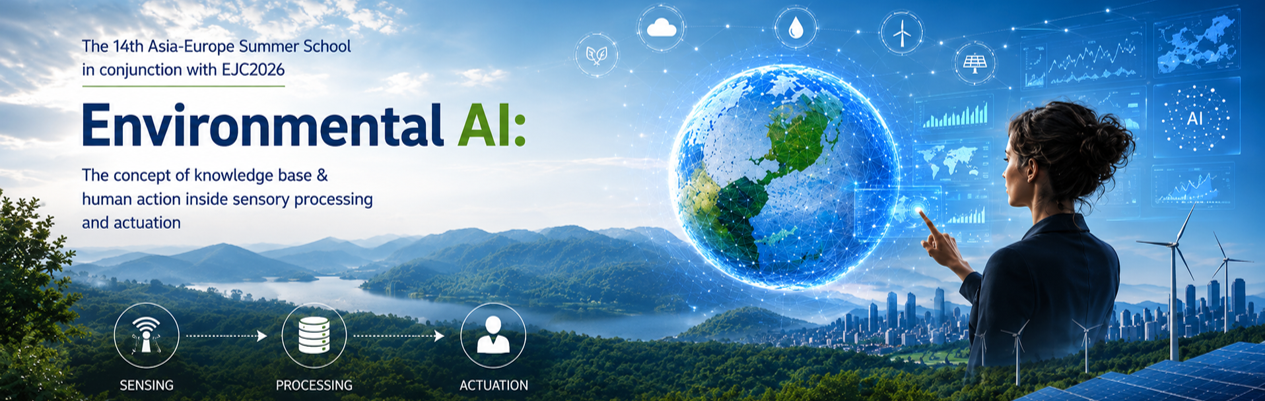
The 14th Asia-Europe Summer School in conjunction with EJC2026
“Environmental AI: The concept of Knowledge Base & Human Action Inside Sensory Processing and Actuation”
Achievement Goals of the Summer School:
Engage in interactive sessions where speakers guide participants to collaboratively design actionable initiatives that aim to preserve and improve our natural environment.
Target groups:
PhD students, master students, and researchers
Focus Areas:
Global Environmental AI, Advancing 5DWM to the next level to inspire and promote contributions to our nature and society.
Organizers:
AI Consortium & 5D World Map System, Asia AI Institute with EJC2026
Location
- Monday, June 8th, 2026
- Onsite: University of Vaasa, Tervahovi Building, Room D221
- Map: Campus Map
- Registration by June 5th. Summer School is free of charge. If you have already registered for the EJC2026 conference, you do not need to register again: Summer School Registration
Description of the Summer School Theme:
Humankind, the dominant species on Earth, faces the most essential and indispensable mission; we must endeavor on a global scale to perpetually restore and improve our natural and social environments. One of the essential computations in AI is context-dependent semantic-computing to analyze the changes of various situations in a context dependent way with a large amount of information & knowledge resources. It is also significant to memorize those situations and compute social and environmental change in various aspects and contexts, in order to discover what is happening on our planet. We have proposed a multi-dimensional computing model, the Mathematical Model of Meaning (MMM) in 1994. As a global knowledge processing system based on MMM, we have realized the “5-Dimensional World Map System” for integrating and analyzing environmental and social phenomena in ocean and land. We introduce the concept of “SPA (Sensing, Processing and Analytical Actuation Functions)” for realizing a global knowledge processing system, to apply it to the 5-Dimensional World Map System. This concept is effective and advantageous to design knowledge processing and environmental systems with Physical-Cyber integration to detect environmental and social phenomena as real data resources in a physical-space (real space), map them to cyberspace to make analytical and semantic computing, and actuate the analytically computed results to the real space with visualization for expressing environmental and social phenomena, casualties and influences. Currently, the 5D World Map System is globally utilized as a Global Environmental Semantic Computing System, in SDGs 9, 11 and 14, United-Nations-ESCAP.
Program
| Opening and Keynote Address
“Global & Environmental AI Architecture for Nature” Yasushi Kiyoki |
13:00-13:20 |
| Panel Session 1: AI Models and Pragmatic AI
Prof. Bernhald Thalheim (Online) |
13:20 – 14:20 |
| Coffee break | 14:20 – 14:40 |
| Panel Session 2: Human action – inclusive data science for natural environment
Prof. Hannu Jaakkola |
14:40 – 15:40 |
| Invited Lecture: Human actor in cyber-physical space
Dr. Juho-Pekka Mäkipää This lecture introduces the concept of cyber-physical space, where digital and physical environments merge. It explores the human as a dynamic actor, considering both static and dynamic factors that influence interaction with IT systems. Key themes include human perception, cognition, and action in relation to technology. A case study highlights how elderly individuals form mental models of cyberspace. The lecture concludes with future research directions, focusing on human-centered design, adaptive systems, and ethical challenges in evolving cyber-physical environments. |
15:40 – 16:20 |
| Closing | 16:25 – 16:30 |