EJC2026 Program Overview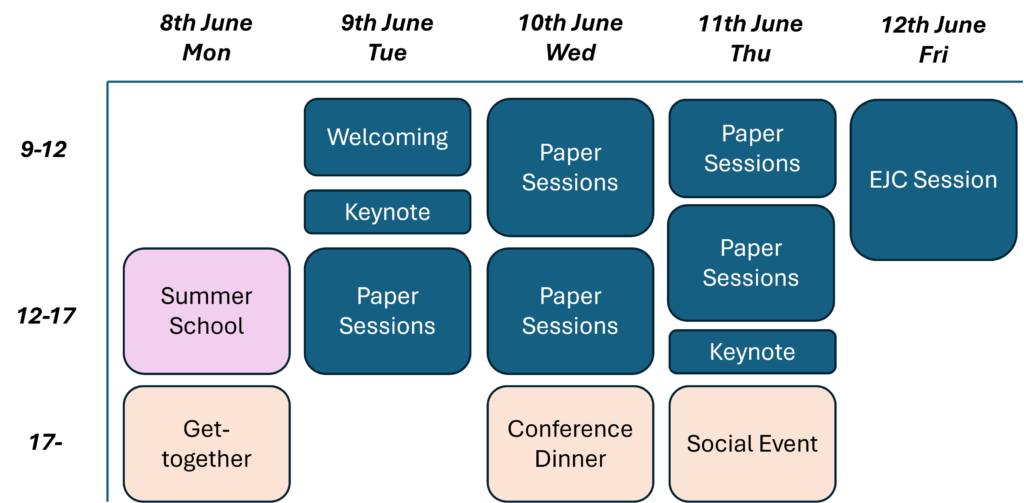
Keynotes:
Tuesday 9th 2026 9:30-10:30
“Tools that use tools to build tools”
Dr. Jussi Rasku
 Postdoctoral Research Fellow
Vice-Head of GPT-lab
SEAMK Fellow
Chair of the Smart Technologies Group
University Consortium of Seinäjoki
Tampere University
Dr. Jussi Rasku is a Postdoctoral Research Fellow at Tampere University acting as one of the Vice Heads of GPT-Lab. His research focuses on generative AI in software engineering, human-AI interaction in requirements elicitation, optimization of operations, and deploying AI into industrial contexts. He works at the intersection of research and practice, integrating data, algorithms, AI models, and decision-support systems into everyday business operations.
Rasku’s background spans, among others, operations research, software engineering, machine learning, meta-optimization, resource planning, vehicle routing, machine vision, IoT, and applied AI. He is active in regional and industrial AI initiatives and projects, including AI Champion project and GPT-Lab Seinäjoki, where the focus is on AI adoption, agentic AI, and practical business deployment.
Thursday 11th 2026 15:15-16:15
“Rethinking AI for Reliability and Imagination in Human Thought Process”
Professor Virach Sornlertlamvanich

Faculty of Data Science
Musashino University, Japan
https://www.virach.com/
In 1998, he earned a doctoral degree in Computer Engineering from the Tokyo Institute of Technology. Subsequently, he served as a sub-project leader for Thai language processing within the Multi-lingual Machine Translation Project at NEC Corporation until 1992. He joined the National Electronics and Computer Technology Center (NECTEC), Thailand, in 1992 and directed research on Natural Language Processing (NLP) at the Thai Computational Linguistics Lab at NICT from 2003 to 2010. His research interests encompass Natural Language Processing, Machine Translation, Information Retrieval, Knowledge Engineering, and Artificial Intelligence. Following a five-year tenure as a lecturer on Information Retrieval at SIIT, Thammasat University, from 2015 to 2023, he currently holds the position of professor at the Faculty of Data Science at Musashino University, Tokyo, since 2019.
This keynote revisits the foundations of artificial intelligence by examining its role in supporting both reliability and imagination mirroring the human thought process. While recent advances in large language models (LLMs) have demonstrated remarkable fluency, versatility, and human-like interaction, these systems fundamentally lack true understanding, reasoning grounded in knowledge representation, and metacognitive awareness. As a result, issues such as hallucination and unreliable outputs remain inherent limitations.
To address these challenges, this talk introduces Semantically Aware Reasoning (SAR) as a complementary framework that augments LLMs with structured knowledge and dual-process reasoning. Inspired by human cognition—particularly the concepts of Sati (mindfulness) and Sampajañña (clear comprehension)—SAR enhances reliability by enabling models to validate, interpret, and act upon knowledge more coherently.
However, reliability alone is not sufficient. Even with improved reasoning, current AI systems remain constrained by existing knowledge. This keynote therefore advances the discussion toward imagination as a higher-order cognitive function, positioned at the apex of a five-stage model of human cognition: from data and knowledge to consciousness, awareness, and ultimately, knowledge creation. Within this framework, imagination is not randomness or hallucination, but a structured transformation across domains.
To operationalize this concept, the talk presents Cross-SVD, a novel method for cross-domain knowledge transformation that preserves latent conceptual structures while enabling reinterpretation in new domains. Combined with generative architectures, this approach opens a pathway from reasoning to creative knowledge discovery.