During the summer of 2026, the STRAIND project shared its research at several international academic conferences. In this blog post, we highlight some of the key insights and lessons learned from these events.
IGU-CDES Conference 2026
International Geographical Union’s Commission on the Dynamics of Economic Spaces
Conference theme: Strengthening economic resilience: Geographies of policies, knowledge co-creation and industry transformations
May 27-29, 2026, Turku School of Economics hosted by the Economic Geography unit, University of Turku, Finland
The IGU-CDES conference was held in the theme of economic resilience and featured keynotes ranging from global economic resilience to local security and resilience in the city of Turku. Looking at resilience in the Nordics, geopolitical and geoeconomic risks are most present. Geoeconomic shifts along supply chains in the global economy nowadays can have a most local effect and institutions like the port of Turku are balancing their preparedness with economic viability.
A presentation by Justine Walter from the Contingency Institute inspired the conference participants to think beyond preparing for probable futures to imagining preferred futures. Resilience is often conceptualised through risk management and the “Zoo of Risks” identifying vulnerabilities based on their visibility, probability and potential impact. However, futures research, and more specifically research on industry transformations, can benefit from broadening their focus from the risk to the desired.
Futures Conference 2026
Finland Futures Research Centre
Conference theme: Sustainability, Temporalities and Futures
June 9-10, 2026, University of Turku, Finland
The STRAIND project attended the Futures Conference, held at the University of Turku on 9-10 June, which attracted several hundred participants. We presented the project’s core research question concerning the spatial dimensions of industrialisation policies and highlighted how connecting our studies to practical cases, such as the cluster study and regional perspectives, enables us to incorporate a temporal dimension into the industrial policy discussion. As we aim to explore future developments, it is important to recognise that spatial configurations are also shaped by past decisions. Therefore, the temporal dimension is equally important to consider in our analysis.
This perspective was well received by the audience, who commented that the project is addressing a highly complex puzzle, while also finding the work very interesting. Many researchers were reflecting on the role of geopolitical developments in their own research and considered the project relevant not only from an industrial policy perspective but also from a broader societal standpoint. Overall, the conference was well organised and featured thought-provoking keynote presentations that challenged prevailing approaches focused on preserving existing structures rather than creating new ones.
ISPIM Innovation Conference 2026
The International Society for Professional Innovation Management
Conference theme: Connecting for Innovation
June 7-10, 2026, Granada, Spain
Also in June 2026, the STRAIND project participated in the ISPIM Innovation Conference in Granada, Spain, with the presentation “The Delphi–BCG Conceptual Framework for Strengthening Entrepreneurial Discovery Processes” (Myllylä & Kaivo-oja). The ISPIM Innovation Conference brings together approximately 500 experts from all continents twice a year. Granada was selected as the conference venue partly because of its world-class fusion energy research activities. The conference programme also included a visit to IFMIF-DONES (International Fusion Materials Irradiation Facility – DEMO Oriented Neutron Source), a key piece of infrastructure for fusion energy research in Spain. Fusion energy is increasingly reshaping energy infrastructure and regional industrial policy and is no longer merely a distant vision. These insights will also be taken into account in the ongoing work of the STRAIND project.
Eu-SPRI Annual Conference 2026
European Forum for Studies of Policies for Research and Innovation
Conference theme: Questioning the contributions of Science and Innovation to Society
June 10-12, 2026, Universitat Politècnica de València, Spain
“Have you ever seen a map with one road?” With this image Prof. Andy Stirling inspired the audience at the Eu-SPRI conference to do multi-dimensional research on innovation. The future doesn’t hold the one transformation, transformation is a multitude and research needs to conceptualise it as such.
At the conference this multi-layerdness was particularly discussed in relation to the term security. In the Finnish context, security is often operationalised with a focus on military security. However, different European countries take different foci of security such as climate, cyber, economy or society. The systemic perspective on security aligns closely with STRAIND and the University of Vaasa’s research on comprehensive security and preparedness, including the activities of the Preparedness and Resilience Research Platform (PREP).
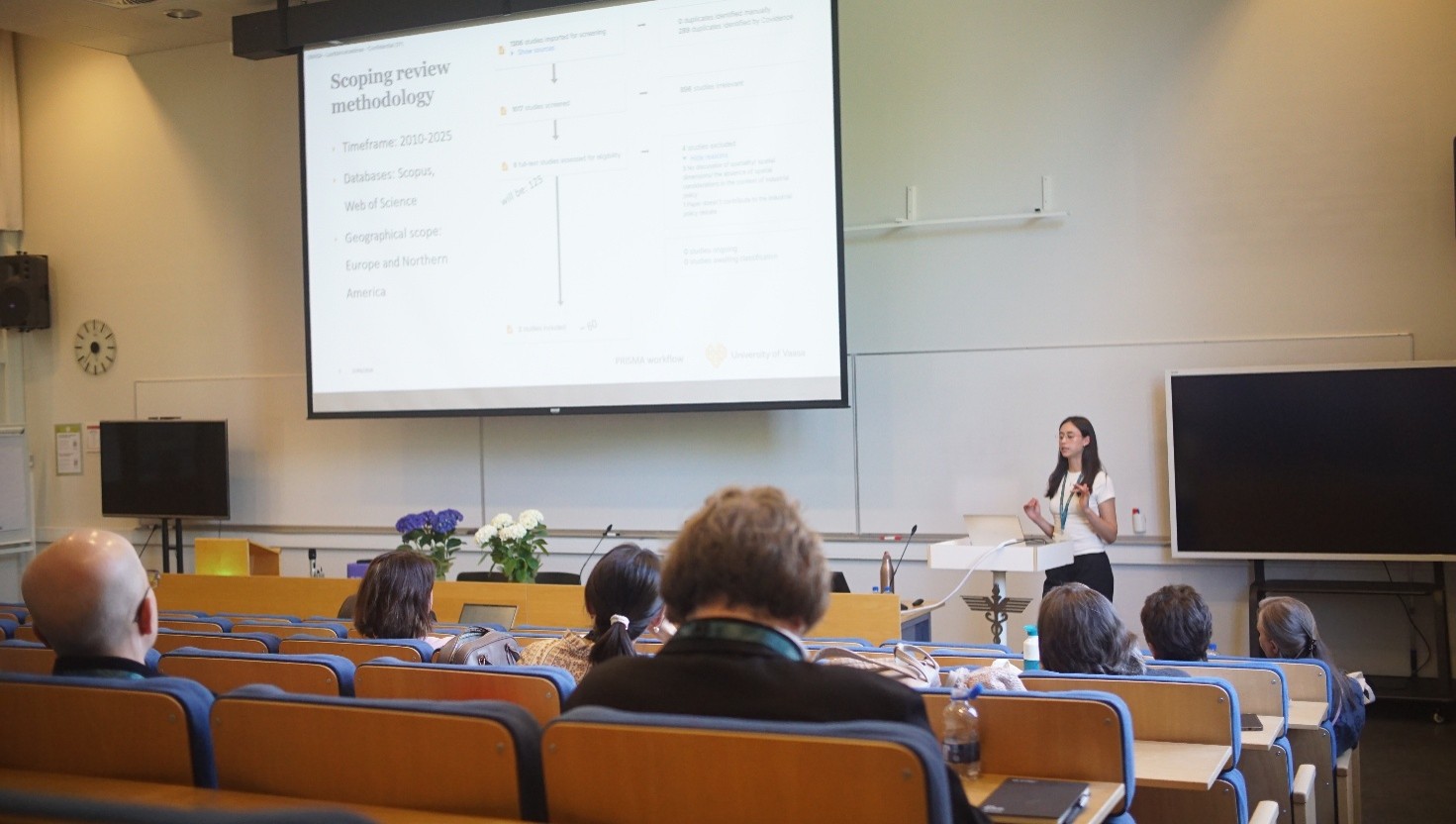
Questioning the contributions of science and innovation to society at the annual conference in València further included a discussion on normative framings. Given the multitude of risks and challenges in today’s world, Dr. Asun Lera St. Clair is the opinion that normative research questions hold the opportunity to make research impactful and societal relevant. Hereby, we should channel hope as motivation to contribute more, not fear. At Eu-SPRI, the STRAIND project presented a work-in-progress scoping review of spatiality in the industrial policy literature.
2026 RSA Annual Conference
Regional Studies Association
Conference theme: Regions as Arenas in a Changing World
June 15-18, 2026, University of Gothenburg, Sweden
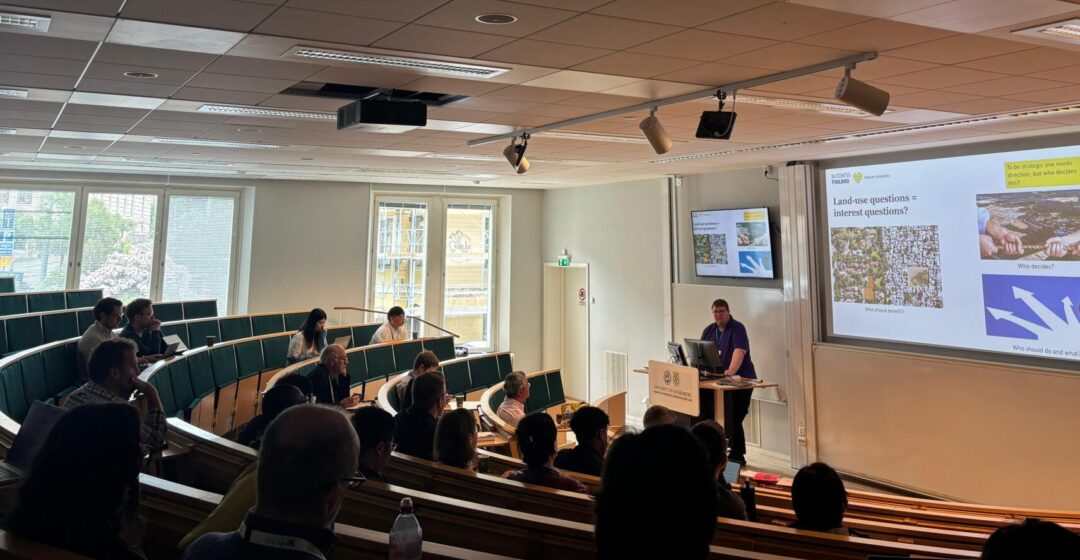
The STRAIND project also visited Gothenburg, Sweden, to participate in the Annual Regional Studies Association (RSA) Conference, held from 15 to 18 June. Compared to the Futures Conference, the focus was more strongly on regional development and planning issues than on future-oriented themes. The STRAIND project presentation examined how land-use questions can be addressed in a multilevel governance setting and how national-level steering may become increasingly important within future regional development frameworks.
One of the keynote speakers was Professor Emeritus Dominique Foray, who has played an influential role in the development of Smart Specialisation. He also argued that policy attention is increasingly shifting towards nation states, both within Europe and more broadly. This development was also highlighted during our presentation, which explored how connections between local and regional levels and the national level could be strengthened. Regions should be able to act as “messengers” between local actors, national development visions, and European-level discussions. The question of whose interests are represented in land-use decisions is also becoming increasingly relevant. This raises important issues of justice and highlights the need for negotiation among different stakeholder groups at the local, national, and perhaps even European level.
6th World Planning Schools Congress 2026
Conference theme: Peripheral Visions – Rethinking Planning
June 29-July 3, 2026, Helsinki-Espoo-Tampere
Under the theme of peripheral visions, the World Planning School Congress suitably brought together spatial planning scholars from around the world in Finland – a place often described as a periphery. During the congress week it became apparent that though geographically at a periphery, Finland is at the center of academic debates. Not rarely planners and scholars look to the Nordics for best practice.
For example, one recurring theme at the congress was multi-level governance. Multi-level governance is a concept highlighting how power can be dispersed across policy levels from local to national and supranational. Especially in the context of geopolitical tensions posing challenges to European cohesion, multi-level governance is a powerful tool. A congress field trip to the Helsinki-Uusima regional council demonstrated what power dispersion can mean in practice. The immense knowledge and plans on regional spatial planning issues presented by the regional councils planning specialists is a powerful product of Finnish governance structures. Additionally, Nordic platforms like the Kvarken Council and VASAB (Vision and Strategies around the Baltic Sea) present other examples of multi-level debates.
The STRAIND project had a strong presence at the congress with two members holding presentations and one coordinating a track. Participating in the conference from our regional studies perspectives on industrial policy certainly was fruitful for discussions with spatial planners and for our further work.