Background
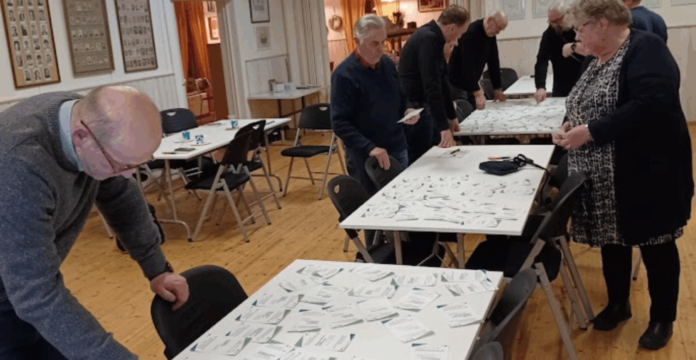
In the PEAK project, we have engaged various stakeholders through interviews and local workshops. The aim of these discussions has for instance been to understand how regional energy production is seen at the local level, where renewable energy production is currently developing rapidly.
These discussions show that actors are highly interested in how energy is produced. Their reasons typically include sustainability aspects, energy prices and also energy resilience concerns. People have realised how important energy production is, and locally produced energy is valued in itself.
Thus, the importance of local energy production has been recognised. However, one of the biggest challenges in advancing local energy production is to get actors to talk to each other. In the PEAK project we have discussed with a range of actors: local decision makers, consumers, producers, researchers, and practitioners from different sectors. We have also engaged residents in discussions about the local energy system.
Based on these conversations, there seems to be a classical “checkmate” position among the actors. Everyone recognises the need to act and the potential for doing so, but the question of who should do what and when is harder to answer. Public organizations are looking at companies, companies are following and waiting for the decisions of public organizations, and residents and research institutions are waiting for investments that could open new opportunities and openings to the game. Instead of continuing considerations in solitude, the PEAK project encourages to increase mutual dialogue – something rather difficult to organize on national or global level, but easier to handle at the local level.
There is a need to coordinate aims of individual actors and this can only be done if there is mutual interaction, which can generate solutions tailored to local conditions. This is the real benefit of local dialogue: it integrates diverse perspectives, and the local context can play a crucial in finding applicable solutions.
Key players
To better understand the actors and thus the “game” it is useful to list the key players and their respective roles in local energy production and consumption. In simplified terms, the key players can be presented in the following way:
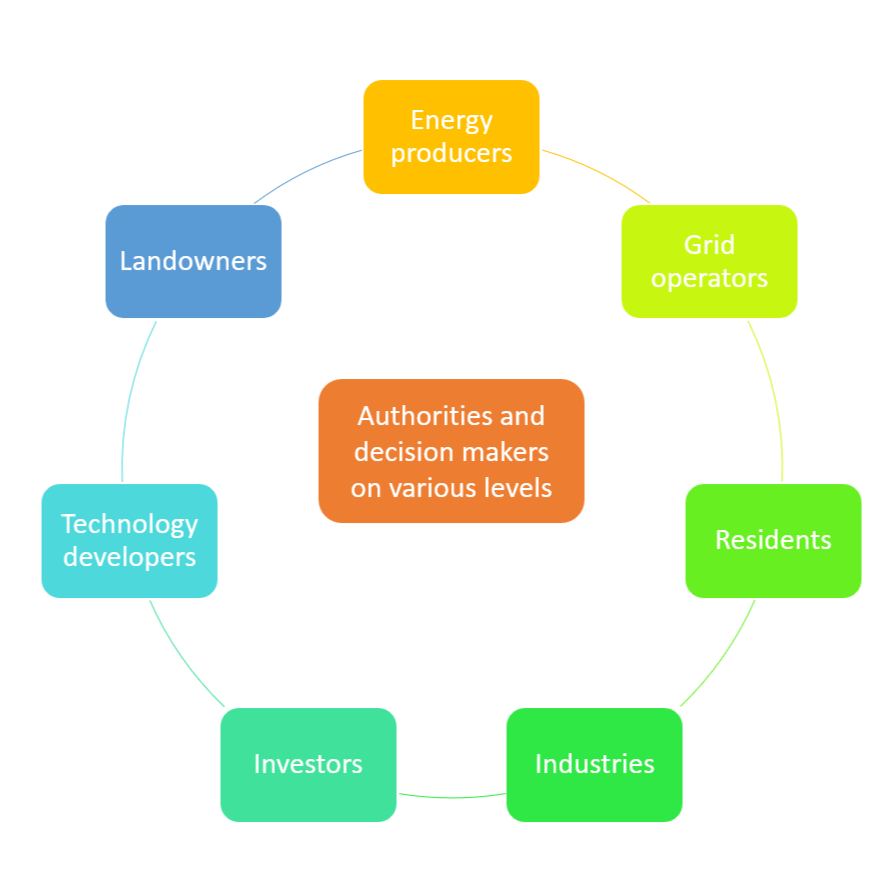
First of all, there are energy producers, which are either privately or publicly owned energy production facilities. These actors play an important role in recognizing which solutions can be integrated into existing systems.
Grid operators are often national entities, such as Fingrid in Finland, which decide how the national network is developed. At the same time, they set boundaries and create opportunities for future production. Gaining the support of the grid operator is crucial for developing future energy systems and this also applies to local energy production.
Both residents and industries are literally the end-users of energy flows and either use them for personal or professional activities. The difference between these two groups are the potential resources to influence and change their energy consumption patterns. Individual residents have limited possibilities to radically change their consumption, whereas industries can have greater capacity to improve efficiency in their activities and to even start to produce energy themselves. However, individuals can also play an important role by influencing the demand side. People are typically interested in energy prices, but are not otherwise heavily involved in energy related discussions, even though there are some engaged individuals.
Investors can be international actors or even local actors, which see benefits in developing renewable energy production whether to reduce costs or increase revenues. Even though local energy production might be seen as a local activity, it is possible that the investors are large multinational companies or foreign investors. Or they can be individuals, which wish to lower their housing costs by producing energy. Investors are usually focused on return on investment and are hoping to benefit from the energy production as quickly as possible.
Technology developers are companies or sometimes researchers, which are testing new technologies or developing new solutions for local energy production. They operate in a challenging field, in which they need to recognize other actors and their specific needs. It should be noted that technology developers are usually operating in a certain part of the energy production and may have knowledge of only a limited number of solutions and not necessarily all potential alternatives, which might make it difficult to apply their solutions.
Landowners play an important role in enabling new production. Ideally, they can participate in renewable energy production in ways that align with their own interests and needs. However, land use issues often involve conflicting perspectives, and interests of landowners must sometimes be balanced against those of the wider community. In developing renewable energy production, it is particularly important to pay attention to so-called brown field construction, that is the use of land for which there is no other use, such as forestry or agriculture. A successful example of this approach is the Esse Elektro-Kraft solar park in Ähtävä, which was built on the site of a former fur farm.
Last, but certainly not least, there are authorities and decision makers on various levels. Even though there are authorities and decision makers on EU, national and regional level, municipal authorities and decision-makers still play a key role in enabling local energy production. Without local support it might be difficult to get necessary permits and create the goodwill needed to enable production. Local authorities and decision makers can sometimes have several competing alternatives on the table and thus need to decide what energy production measures are the best ones from a local point of view.
So, who should make the next move?
As described above, there are various actors in the game and sometimes individuals have multiple roles. So how can the energy production playing field be shifted to increase renewable energy production? The regulatory framework or public funding can offer opportunities for public institutions to influence the playing field, whereas companies often need resources and knowledge about local conditions. This is backed by the research and development institutions as well as residents steering developments and opening up possibilities for energy transition by influencing demand as well as offering relevant and case specific information.
Because local conditions, potential solutions and the setup of actors vary, prescribing exact moves is difficult. Instead, it is useful to learn from the moves of others and see how successful energy production projects have been developed to learn more about the processes. Regardless of who makes the first moves, it is important to understand that moves should be made and that communication among actors is one way to reduce uncertainty regarding game plans. In the PEAK project, we will continue working with local actors to better understand the mechanisms, which could be applied to enhance sustainable energy production.
Like in a professional chess-game, time is also a factor. Large renewable energy investments are approaching, and decisions made today will shape the future. Municipalities can act proactively, for example by dedicating land to renewable energy production, if this is supported locally. It can also be useful to proactively identify areas where sustainable energy production is not desired, clarifying the playing field for potential investors. This can for example include communication in reports in English concerning local areas, which help international actors in the decision-making. Whatever moves different actors are considering, the time to discuss local energy production is now. This ensures a future where everyone feels included. That is why we continue discussions in Ostrobothnia and develop solutions together in the PEAK project.
Antti Mäenpää, University of Vaasa