
We have collected data and lived experiences from individuals with neurodevelopmental conditions. To date, more than 400 participants have taken part in our research, including employees from various professional fields with ADHD, neurodivergent students, and representatives of organizations. Based on these experiences, we are compiling a handbook.
One important perspective emerging from our research is that many neurodivergent individuals remain undiagnosed. This is often because their neurodevelopmental condition may not cause significant difficulties earlier in life. But this does not mean that they do not experience the same challenges once the demands of higher education and working life increase. As cognitive, organizational, and social demands grow, previously manageable differences can become much more visible and burdensome.
It is therefore crucial that we do not overlook neurodivergent conditions or reduce them to personality traits or “bad habits” that could simply be trained away. Neurodivergence reflects a heritable way of brain functioning that does not change. While certain skills can be practiced and the brain can be trained, some challenges require workarounds in environments that are still largely designed around neurotypical norms. Individuals have a right to these accommodations and adaptations.
Another key perspective in our research is that you are good as you are. You have natural strengths, and while it is important to identify workarounds for areas that feel difficult, it is equally important to create conditions that allow your strengths to be recognized, supported, and fully utilized.
What is neurodiversity? Read more here
Why life may have felt difficult, and why it’s not your fault?
Many neurodivergent people grow up feeling that everyday life is harder than it “should” be. This experience varies greatly depending on:
🧠whether a diagnosis was received early or late
🧠whether appropriate support, understanding, or treatment was available
🧠whether differences were recognised as neurodevelopmental or interpreted as personal failure
Without a diagnosis or support, many people internalise difficulties as laziness, incompetence, or lack of discipline. In reality, challenges often stem from mismatches between the brain and the environment, not from lack of ability. Late diagnosis is common and often brings both relief and grief: relief in understanding oneself, and grief over years spent struggling without support.
Why do I get overloaded?
Understanding how your brain works helps you distinguish between what you can influence and what you cannot easily change. This knowledge is essential for reducing self-blame and focusing your energy where it actually makes a difference. Neurodevelopmental conditions are not about a lack of effort or motivation, but about how the brain processes information, regulates attention, and responds to stimulation.
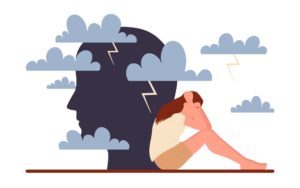
People with neurodevelopmental conditions such as ADHD and autism tend to become overloaded more easily because their brains process information more intensely and less selectively. In environments with noise, bright lights, constant information flow, or sustained cognitive and social demands, the brain may remain in a prolonged state of alert. Instead of automatically filtering out irrelevant input, it attempts to process many signals at once, as if everything might be important. This creates a sense of constant readiness and can quickly exhaust mental resources.
This overload is linked to how different brain regions interact. The prefrontal cortex, which is responsible for focus, planning, prioritisation, impulse control, and self-regulation, plays a central role in managing attention. When the prefrontal cortex receives too much competing information, its ability to organise and regulate behaviour weakens. This makes it harder to decide what to focus on, switch tasks smoothly, or inhibit distractions. Everyday situations that require sustained attention or rapid decision-making can feel disproportionately demanding.
Deeper brain structures involved in emotional processing and involve amygdala and the limbic system. These areas are designed to detect threat and significance, but when they are highly responsive, emotional reactions can become stronger and faster. For some neurodivergent individuals, this means that social situations, especially those involving conflict or ambiguity are experienced more intensely and require greater effort to regulate. Emotional processing and cognitive processing then compete for the same mental resources, increasing overall load.
Another contributing factor is how internal and external attention are balanced. The brain’s default mode network, which supports internal thought, reflection, and self-monitoring, may remain active even when external focus is required. This can lead to mental noise, intrusive thoughts, or a sense of “brain fog,” making it harder to stay anchored in the present task or interaction. When internal and external demands overlap, cognitive effort increases significantly.
Neurotransmitters also play an important role in overload. Dopamine influences motivation, focus, and the ability to initiate and sustain effort. When dopamine signalling is uneven, tasks that are not immediately rewarding require much more effort, increasing fatigue. Noradrenaline regulates alertness and stress responses; when its levels remain elevated, the brain stays in a heightened state of arousal, which supports short-term performance but accelerates exhaustion. Glutamate, the brain’s main activating neurotransmitter, supports fast thinking and learning, but when activation is high without sufficient inhibition, thoughts can race and sensory input can feel overwhelming. Gamma-aminobutyric acid (GABA), the main calming neurotransmitter, helps dampen excess stimulation, and when its regulation is weaker, the brain has more difficulty slowing down and recovering.
You can influence:
🌱 neurotransmitter balance, for example via medication (when appropriate) and everyday choices such as sleep, nutrition, movement, and stress regulation
🌱 energy, focus, and recovery by building supportive routines
🌱 task-switching by practising transitions and reducing abrupt changes
🌱 cognitive load by breaking tasks down and prioritising intentionally
🌱 your environment by adjusting noise, light, sensory input, social contact, and interruptions
🌱 recovery by planning rest, pauses, and low-demand time
You cannot easily influence:
🧠 your genetic background and individual neurodevelopmental starting points
🧠 how your brain is wired or how it processes information
🧠 how strongly your brain reacts to stimuli
🧠 how quickly your nervous system becomes overloaded
🧠 baseline regulation of neurotransmitters
🧠 emotional sensitivity or intensity
🧠 the need for recovery after high cognitive or social load
Should you disclose a neurodivergent diagnosis?
Why disclosure can help
Disclosing a diagnosis can:
🔓make it easier to request reasonable support or adjustments
🔓reduce self-blame and constant masking
🔓improve mutual understanding in studies or work
🔓allow strengths to be used more intentionally
When disclosure can be a risk
Disclosure may feel risky when:
🛡️the environment lacks psychological safety
🛡️neurodiversity is poorly understood
🛡️stereotypes or stigma are present
🛡️decisions about suitability or reliability may be influenced
Disclosure is always voluntary. You are not obligated to share diagnoses — only information that is necessary to support your functioning.
A practical “rule”
You do not need to disclose a diagnosis to ask for support.
You can describe functional needs instead:
I work best with clear deadlines and written instructions.
Are there professions you cannot enter with ADHD or other diagnoses?
This depends on the country, the profession and safety-critical requirements. Some highly regulated professions (e.g. certain military, aviation, or security roles) may have restrictions related to untreated conditions that could affect safety. However, many restrictions are context-specific, not absolute. Also, treatment, coping strategies, and individual functioning matter. Most academic, professional, and creative fields are fully accessible. A diagnosis does not determine competence or career potential. Many neurodivergent individuals thrive in demanding expert, leadership, and creative roles.
What support can you expect in higher education and working life?
In higher education, typical supports may include:
🎓extended time for exams
🎓alternative assessment formats
🎓accessible learning materials
🎓flexible deadlines when justified
🎓assistive technologies
🎓clear structure and guidance
🎓help from student health care, school psychologist / curator /neuropsychiatric coach
In working life, support may include:
💼flexible working hours or hybrid work
💼adjustment in work place and ergonomics
💼support with task prioritisation and clarity
💼reduced unnecessary interruptions
💼assistive tools and technologies
💼support from occupational health provider
Note! The goal of the support should not be about changing who you are, but to remove barriers that prevent you from performing at your best.
Learning to know yourself
Self-understanding is one of the most powerful tools for neurodivergent people. Key questions to explore:
🌱What drains my energy? What restores it?
🌱What environments help me focus?
🌱What tasks do I start easily and which ones block me?
🌱How do stress, sleep, and overload affect me?
Self-knowledge is not about fixing yourself, but more so it’s about working with your nervous system, not against it. Find strengths in a diagnosis, examples:
💎ADHD: creativity, speed, intuition, leadership, adaptability
💎Autism: depth, precision, reliability, expertise
💎Dyslexia: big-picture thinking, creativity, communication
💎Dyspraxia: strategic thinking, empathy, originality
💎OCD: quality, accuracy, responsibility
Read more here
Tips for finding and maintaining focus
Maintaining focus can be challenging, especially when tasks feel complex, unclear, or overwhelming.
These practical tips are designed to support attention, lower cognitive load, and make it easier to get started and stay engaged with your work or studies.
💡Break tasks into very small, concrete steps.
Example: If you starting a new course or project, list all of its assignments and deadlines on a timeline, and then break them into smaller pieces.
💡Use external structure (timers, checklists, calendars).
Example: Make a daily check-list the day before.
💡Create predictable routines.
Example: Have ONE routine a day that helps you organize your thoughts in a to do / check list.
💡Agree a schedule with a friend.
Example: Agree to work on an assignment while your friend is working on hers/his.
💡Use a sensory friendly space.
Example: Use a sensory space as your focus room on a certain point of time of a week and day.
💡Use visible lists on your fridge or workplace.
Examples of digital tools: Trello.com or Google Tasks / Google Calendar
💡Reduce friction: prepare tools and materials in advance, make it tempting for you to get onto your studies / work.
Example: place your work / study equipment in an order which helps you to get started the day after.
💡Alternate focus-intensive tasks with movement or rest.
Example: Decide 3 big tasks for the day, and 5 small ones, and place them in an order that gives you a feel of change.
💡Use automatic reading tools to listen to difficult text.
💡Enhance focus with side-activity.
Example: Go for a walk or do the dishes or make a drawing while listening to a pre-recorded lecture or other.
💡Work with motivation, not against it.
Example: Reward yourself throughout the day. Plan a reward (a coffee break, a walk outside, eat an apple) after every demotivating or difficult task. “I do this first and then I take a break / have an apple / call a friend / check my SoMe”
Tips for reading difficulties
📖Use text-to-speech tools
📖Prefer summaries and visual materials
📖Read strategically, not line by line
📖Use fonts and layouts that reduce visual strain
📖Allow extra time for reading-heavy tasks
See videos from Datero ry and Erilaisten oppijoiden liitto / Diverse learners’ Association (in Finnish).
See Datero’s smart tools and Erilaisten oppijoiden liitto
Tips for writing difficulties
✍️Use speech-to-text tools
✍️Dictate first, edit later
✍️Separate thinking from writing
✍️Use templates and clear structures, draw a picture of your thoughts first
✍️Don’t aim for perfection in the first draft
AI can help with:
🤖Summarising texts: Upload your material in the tool and prompt for a simple / plan language explanation of the content.
🤖Structuring ideas: Feed your not so structured ideas via text or speech to the tool and ask it to structure it for you.
🤖Clarifying instructions: Upload your course syllabus to the tool, and ask it a plan language version and a clear schedule of all assignments. The same goes with other instructions – take a photo of paper instructions and feed it in, ask for a step-by-step plain language instruction.
🤖Reducing language barriers: Ask for translations, improve your language, ask for language-proofing
🤖Supporting planning and prioritisation: You can ask AI to make your monthly and weekly schedule and task list
🤖Healthy habits: You can ask AI to make you a meal plan with certain amount of energy with a limit for cost
🤖Motivation: Ask AI to plan your EXAM questions from a material or list of preparations you need for a presentation or a meeting
🤖Rehearsing: Rehearse your job interview or other situation with AI
Read more about neurodiversity and recruitmet here.
Learn to Use Your Strengths
Did you know that neurodevelopmental conditions may once have played an important role in human survival? For example, ADHD is often associated with heightened responsiveness and sensitivity to stimuli—traits that were valuable in the environments where our ancestors lived. Some individuals developed a strong ability to notice details and shape tools. Others had pronounced strengths in maintaining routines, order, and double-checking, helping communities avoid dangers. Some brains evolved to take risks and explore, because discovering new areas was essential for finding food. Others developed exceptionally strong visual memory.
These traits are still present today in different neurodivergent profiles. However, modern society is largely built around neurotypical norms and expectations. In such environments, traits that differ from the norm can become overemphasized and, in some cases, framed as problems rather than differences. Yet in today’s rapidly changing world, where quick sense-making, problem-solving, creativity, and adaptability are increasingly needed, neurodivergent traits can be powerful strengths, if not your superpowers. Have you ever considered that a trait in you that others find unusual might actually be one of your greatest assets, and that you don’t need to change who you are? Instead, our environments need to become more neuro-friendly.
Here’s a practical starting point. You can begin by identifying your strengths, for example by completing a strengths assessment based on positive psychology, such as the VIA Character Strengths survey. The tool is free to use once you register with your email address.
After that, take a moment to reflect on the following questions:
- How do my top three strengths show up in my work or studies, in my friendships, and in my other roles in life?
- How do I use these strengths when I face conflict or challenging situations?
- How will I intentionally use these strengths in the coming week?
Recognizing and working with your strengths is not about fixing yourself. It is about understanding how you function best—and creating conditions where you can thrive.
Influence your brain
Neurodivergent brains do not work “wrong”, but they work differently. These differences are largely explained by how brain networks communicate and how certain neurotransmitters (chemical messengers in the brain) are regulated. Neurotransmitters influence attention, motivation, emotional regulation, energy levels, stress responses, and recovery. In neurodevelopmental conditions, these systems are often less stable or less predictable, which explains many everyday challenges, especially when demands increase in higher education or working life. Importantly: this is not about willpower. These processes happen automatically in the nervous system. Below are the key neurotransmitters involved, what they do, and how people can influence them in everyday life. Working with your nervous system means that you to recognise what drains you, what restores you, and what kind of structure your brain needs. You can design your environment and routines thereafter.
Dopamine
Dopamine is central to motivation, reward, initiative, and task initiation. In many neurodivergent people, especially those with ADHD, dopamine regulation is more selective. This means motivation is strongly tied to interest, urgency, novelty, or meaning.
As a result, starting tasks can feel disproportionately difficult, routine work may trigger procrastination, and motivation may suddenly surge only under pressure or strong interest. At the same time, this same system enables creativity, fast ideation, and intense hyperfocus when something truly engages the brain. You can support dopamine by:
☑️breaking tasks into very small, concrete steps
☑️using checklists, visible progress, and short-term goals
☑️building in frequent rewards and moments of completion
☑️working with interest and meaning whenever possible
☑️supporting dopamine nutritionally with regular meals, enough protein, and foods rich in tyrosine (e.g. eggs, fish, legumes, dairy)
The goal is to cause regular small signals that make starting and continuing possible.
Noradrenaline
Noradrenaline regulates alertness, attention, and how the brain responds to stress. When its regulation is uneven, the nervous system may swing between under-activation (fog, disengagement) and over-activation (restlessness, anxiety).
This can explain why focus feels unstable, why interruptions are exhausting, and why some neurodivergent people perform exceptionally well under pressure but feel drained afterwards. The brain is working hard to stay alert in environments that demand constant self-regulation. You can support noradrenaline by:
☑️creating clear structure and predictable routines
☑️reducing unnecessary interruptions and noise
☑️using short work cycles with regular breaks
☑️alternating demanding tasks with movement or rest
☑️supporting stable energy levels with regular meals, complex carbohydrates, nuts, seeds, bananas, and sufficient hydration
Structure helps the brain stay alert without tipping into overload.
Serotonin
Serotonin supports emotional regulation, impulse control, and overall wellbeing. Lower or fluctuating serotonin levels can increase emotional intensity, sensitivity, and vulnerability to stress or low mood.
For many neurodivergent people, this shows up as strong emotional reactions, high empathy, emotional fatigue, or difficulty recovering after socially or emotionally demanding situations. These are not character flaws, but they actually reflect a nervous system that reacts deeply to its environment. You can support serotonin by:
☑️prioritising regular sleep and daylight
☑️physical activity and time outdoors
☑️positive social connection and encouragement
☑️psychologically safe, calm environments
☑️laughing, singing and dancing
☑️supporting serotonin nutritionally with complex carbohydrates, tryptophan-rich foods (e.g. oats, dairy, nuts, seeds), and adequate vitamin B6
Feeling safe, supported, and valued directly affects emotional regulation at a neurobiological level.
Glutamate
Glutamate is the brain’s main activating neurotransmitter and plays a key role in learning, memory, and problem-solving. When glutamate activity is high or poorly regulated, thinking can become very fast — but also overwhelming.
This can feel like racing thoughts, difficulty filtering information, or cognitive overload. At the same time, it enables rapid problem-solving, creativity, and the ability to see connections others miss. You can support glutamate balance by:
☑️using interactive and multisensory learning methods
☑️avoiding long periods of passive input
☑️taking regular breaks between cognitively demanding tasks
☑️building in recovery after intense focus
☑️supporting balance through diet by reducing excess sugar and ultra-processed convenience foods, and ensuring sufficient omega-3 fatty acids (e.g. fatty fish, flaxseed, walnuts)
The her is to balance intensity with rest.
GABA
Gamma-aminobutyric acid (GABA) is the brain’s main calming neurotransmitter. It helps slow things down, reduce overload, and support recovery. When GABA regulation is weaker, it can be hard to calm the nervous system, switch off after work or study, or recover from stimulation.
This explains why rest may not feel restorative unless it is intentional and sensory-friendly. You can support GABA by:
☑️taking regular pauses and breaks
☑️breathing and relaxation exercises
☑️gentle movement such as walking or yoga
☑️clear boundaries between work and rest
☑️supporting calming processes with magnesium-rich foods (e.g. nuts, seeds, leafy greens), fermented foods, and sufficient vitamin B6
Recovery is a prerequisite for your durable functioning.
Activate your vagus nerve
The vagus nerve is the longest nerve in the human body, extending approximately 4–5 metres from the brainstem through the neck and chest to the heart, lungs, and digestive organs. Because of its length and reach, it plays a crucial role in connecting the brain and the body. The vagus nerve influences heart rate, breathing, digestion, emotional regulation, and the body’s ability to recover from stress.
The vagus nerve is a central part of the parasympathetic nervous system, whose main task is to calm the body, restore balance, and support recovery. While the sympathetic nervous system prepares the body for action (“fight or flight”), the parasympathetic system supports “rest and digest.” When the vagus nerve is activated, the body shifts out of constant alert mode: heart rate slows down, breathing becomes deeper, digestion improves, and the nervous system signals that it is safe to relax.
For many neurodivergent people, the nervous system can be more easily overactivated. This makes conscious vagus nerve activation especially important, as it helps regulate stress, reduce overload, and support sustainable functioning.
Ways to activate the vagus nerve include:
🌬️slow, deep breathing with a longer exhale than inhale, and a long break after exhale
🌬️gentle humming, singing, or vibrating sounds
🌬️stretching, slow walking, or gentle yoga
🌬️placing a hand on the chest or belly to support calm breathing
🌬️taking short pauses during the day to intentionally slow down
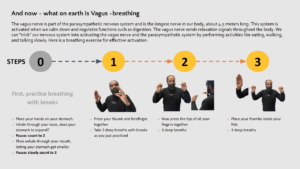
Easy, calming breathing exercise
Prioritisation exercises
Prioritisation exercises help reduce cognitive overload by moving decisions out of the head and into a visible structure. For many neurodivergent people, everything can feel equally urgent, which keeps the brain in a constant alert state. When tasks are prioritised intentionally, the nervous system receives a signal that not everything needs attention at once. This supports focus, lowers stress, and makes starting easier. Prioritisation is not about doing more — it is about deciding what matters most right now and allowing the rest to wait.
Ways to practise prioritisation include:
🧭 listing all tasks before starting work
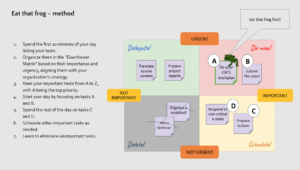
🧭 sorting tasks by importance and urgency (e.g. using an Eat that Frog matrix)
🧭 choosing one or two top-priority tasks for the day
🧭 breaking priorities into small, concrete next steps
🧭 consciously postponing or removing low-priority tasks
Easy, prioritizing tool
The Pomodoro technique
The Pomodoro technique supports focus by working with the brain’s natural attention span. Instead of expecting continuous concentration, work is divided into short, time-limited focus periods followed by regular breaks. This rhythm reduces overwhelm, helps regulate energy, and makes effort feel more manageable. For people with ADHD traits, Pomodoro provides external structure for time and helps initiate tasks without needing to feel “ready” first. Breaks are a built-in part of the method and support recovery, not distraction.
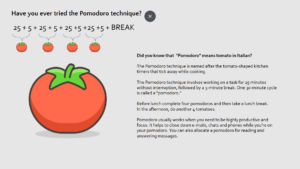
Ways to use the Pomodoro technique include:
🍅 working for 25 minutes on one task without interruptions
🍅 taking a 5-minute break after each focus period
🍅 repeating the cycle 3–4 times before taking a longer break
🍅 deciding the task for each Pomodoro in advance
🍅 using Pomodoro blocks for both focus work and recovery